
What's on · Sat 21 Nov 2026
Cebu City beyond the fiesta: the historic core and the food
Most visitors meet Cebu City through Sinulog, or through an airport on the way to a beach. The city underneath is the oldest in the Philippines, and its historic core fits into a single walkable square: the Basilica and Magellan's Cross, Fort San Pedro, the merchant houses of the Parian, and Colon, the country's oldest street. This guide walks that core in the order the history happened, then eats the city properly: lechon, sutukil on Mactan, and the hanging rice that ties it together.
Cebu City has a problem of timing. The world arrives for Sinulog in January, when the historic core is a stage set inside a festival, or it passes through the airport on Mactan on the way to somewhere with a beach, and never arrives at all. Both miss the same thing: the oldest city in the Philippines, founded as a Spanish settlement in 1565 on a shore where Ferdinand Magellan had planted a cross and lost his life forty four years earlier, keeps its whole founding story inside about one square kilometre of downtown streets. It is walkable in a morning, readable without a degree in colonial history, and it ends, as everything in Cebu should, with lunch. Our Sinulog 2027 guide covers the week the core fills with dancers. This is the core on an ordinary day, which is when it explains itself best.
Start where the city starts: the Basilica and the Cross
Begin at the Basilica Minore del Santo Niño, because Cebu does. The church stands on the site where, in 1565, a Spanish soldier found the image of the Santo Niño, the child Jesus, preserved in a burnt house forty four years after Magellan's expedition had given it to Cebu's rulers at their baptism in 1521. The Augustinians built on the spot, the devotion never left, and the present stone basilica, completed in the eighteenth century, is the centre of the oldest Christian devotion in the country. Go inside respectfully and go early: the basilica is a working church with masses through the day, a dress code enforced at the door, and a queue for veneration that builds by mid morning. The museum upstairs, often missed, holds the image's capes and the church's centuries in objects.
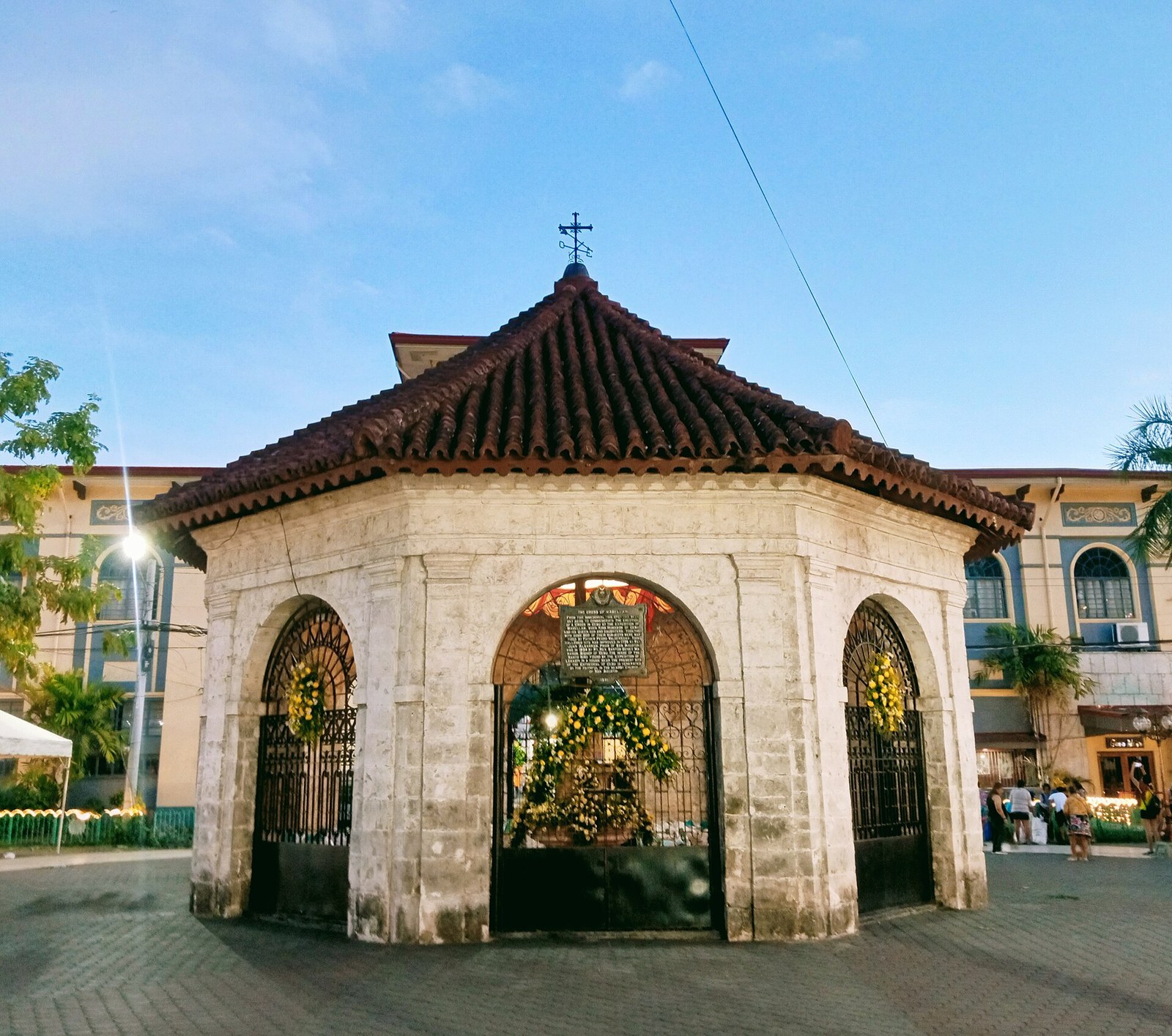
Beside it, inside the small octagonal pavilion in our hero photograph, stands Magellan's Cross, planted by the expedition in 1521 and now encased in a hollow tindalo wood cross to protect the original from the souvenir chipping of centuries of devotees. The ceiling painting tells the baptism scene; the candles and the flower garlands at the gates tell you the site is a shrine first and a photo stop second. Give the pair of them an unhurried hour. Everything else in the old city is a footnote to what happened on this block.
The fort, the plaza and the oldest street
Five minutes south stands Fort San Pedro, the smallest and oldest triangular fort in the Philippines, begun under Miguel Lopez de Legazpi in 1565 and finished in its stone form much later. It has been a garrison, a prison, a school and a zoo across its long life; today its thick coral stone walls hold a small museum and a quiet garden courtyard that is the calmest green space in downtown Cebu. Walk the ramparts for the view over Plaza Independencia, the broad square beside it, then turn north into the streets the Spanish actually traded on.
Colon Street, which runs up from the waterfront, is recognised as the oldest street in the Philippines, laid out in the Spanish period and still the downtown's working artery of jewellers, cinemas turned shops and jeepneys. It is not a preserved heritage street and does not pretend to be; that is its value. A block or two east, the Parian district was the quarter of the Chinese mestizo merchants who made colonial Cebu rich, and two houses survive to prove it. The Casa Gorordo Museum, on Lopez Jaena Street, is a nineteenth century merchant's house of stone and hardwood, furnished to the life its family lived and run as the old city's best house museum. A short walk away, the Yap Sandiego Ancestral House, built in the late seventeenth century, claims a place among the country's oldest surviving houses and is still crammed with the family's own objects. Between them they do what no monument can: they show you the domestic city that paid for the churches.
Book the Cebu City historical and street food tourvia Klook · affiliate link
That half-day loop, basilica, cross, fort, Colon and the two houses, is the whole founding argument of the Philippines in walking distance. If you would rather have it narrated, the afternoon tour above covers the Cross, Fort San Pedro and the heritage sites with street food folded in, and it runs late in the day when the stone has cooled.
Above the old city: the Parian to the hills
The old core also has a vertical dimension, and it is worth an hour at the end of the day. Behind the downtown, the city climbs. In Beverly Hills, the subdivision in the hills above the centre, the Cebu Taoist Temple rises in tiers of green tiled roofs and dragons, built by the city's Chinese community in 1972 and open to visitors who climb its steps respectfully; it is the Parian's modern echo, the same merchant culture at prayer, with the whole city and the strait laid out below it. Further up the Busay road, the city gives up entirely and becomes viewpoint: the Tops lookout, a great stone terrace on the mountain spine, looks down over Cebu City, Mactan and the islands beyond, and it is at its best in the last hour of light, when the downtown you walked all morning lights up beneath you street by street. The Temple of Leah, the vast Roman-styled shrine a Cebuano grandfather built for his wife on the same road, divides opinion architecturally and settles it with the same panorama. Do the hills last, in that order, temple, shrine and terrace, and come down in the dark to a city that has changed from a history lesson into a place you are staying in.
The food: lechon first, then the sea
Cebu's second argument is edible, and it starts with lechon. The city's roast pig, slow turned over charcoal with lemongrass and spring onion, skin like amber glass, is the version of the dish the rest of the country measures itself against, and Cebuanos will tell you it needs no sauce, which is both a boast and, on the good ones, true. Eat it the local way: by weight at a lechon house, with puso, rice cooked in woven coconut leaf packets that hang in bunches and open like origami, and your hands doing most of the work. The famous names around the city each have their loyalists; the honest advice is to go where the lunch queue of office workers is longest and order a quarter kilo more than you think you need.
For the sea, cross to Mactan. The island that holds the airport and the resorts also holds sutukil, the Cebuano seafood formula whose name is a menu in three syllables: sugba, grill; tuwa, stew in broth; kilaw, cure raw in vinegar. At the sutukil rows near the Mactan shrine, you pick your fish, squid, scallops and prawns from the day's catch on ice, name one of the three treatments for each, and eat them twenty minutes later with the harbour in front of you. It is the best seafood lunch in the metro and it sits ten minutes from the site where Lapulapu's warriors killed Magellan in the shallows in 1521, which the shrine on the same shore commemorates. History and lunch, again, in one stop.
Book Mactan island hoppingvia KKday · affiliate link
Stay on Mactan for the afternoon and the water is the plan: the island hopping boats run out to the marine sanctuaries of Hilutungan and Nalusuan and the Caohagan sandbar, which our site's Cebu pages cover in detail and the KKday product above books with the sanctuary stops included in the day. Back in the city by evening, the old core has one more mood: the basilica plaza lit, the Cross pavilion glowing as in our photograph, and the downtown settling into the version of itself that has nothing to prove. Cebu beyond the fiesta is not a lesser Cebu. It is the original one, and it was here first.
Stay in Cebu Cityvia Trip.com · affiliate link
More reading on the articles page, or go straight to the events calendar.
Noteworthy events direct to your inbox.
Get what's noteworthy for the weekend and beyond every Wednesday in your inbox.