
What's on · Mon 16 Nov 2026
Bohol in a day from Cebu: Chocolate Hills, tarsiers and the Loboc river
Bohol sits two hours by fast ferry from Cebu City, close enough to do in a day if the day is built properly. This is the standard countryside loop in the order the road actually runs it, from the Blood Compact shrine and Baclayon Church up through the Loboc river lunch to the Chocolate Hills at Carmen, with an honest account of the tarsier stop: the Philippine Tarsier Foundation sanctuary at Corella is the genuine one, and it is not the stop every tour uses. Plus the overnight version, based on Panglao, for anyone who takes one look at the timetable and decides the island deserves a night.
Bohol is the day trip Cebu keeps in its pocket. From a base in Cebu City, where our New Year guide to Cebu and Boracay already sends you for the waterfront countdown, the island across the strait holds the most concentrated countryside circuit in the Visayas: a 1565 treaty shrine, a church founded in 1596, the smallest primates most visitors will ever see, lunch on a river boat, a forest planted by hand, and a field of more than a thousand near identical hills at the far end of the road. All of it fits into one long day, provided you accept what the day actually is: an early ferry, about six hours on Bohol's roads and water, and an evening ferry home. Here is the loop in the order it runs, and the one stop worth interrogating before you book.
The crossing sets the day
Everything hangs on the boat. OceanJet fast craft run from Pier 1 in Cebu City to Tagbilaran, Bohol's capital and port, in about two hours, with sailings from around dawn through the late afternoon. A day trip lives or dies on the first boats out and a mid to late afternoon boat back, which is why most visitors do not assemble this day themselves: the booked tours bundle the return ferry, the van waiting at Tagbilaran port and every entrance into one early pickup, and on a route this timed that bundling is the product. If you do it independently, book the ferry seats first, in both directions, and be at Pier 1 well before departure, because check in, terminal formalities and boarding eat the margin that the timetable pretends you have. One honest warning that belongs at the top rather than the bottom: fast craft are weather dependent, sailings are suspended when the sea says so, and November is the tail of the storm season. Do not put this day immediately before a flight home.
The loop, in the order the road runs it
From Tagbilaran the countryside road runs in one direction, inland and uphill, and the standard loop follows it rather than crisscrossing the island. First, minutes from the port in Bool, comes the Blood Compact shrine, the Sandugo: bronze figures by National Artist Napoleon Abueva marking the 1565 blood compact between Miguel Lopez de Legazpi and Datu Sikatuna, usually described as the first treaty of friendship between Spaniards and Filipinos. It is a ten minute stop and the right overture, because everything else on the road is a consequence of the century it opened. Next is Baclayon Church, founded by the Jesuits in 1596 and finished in its present coral stone form in 1727, one of the oldest stone churches in the country and a National Cultural Treasure. It was badly damaged in the 2013 earthquake and has since been restored; go inside, because the museum and the worn coral stone do more explaining than any viewpoint on the island.
The road then reaches the tarsiers, which get their own section below, and climbs to Loboc for the middle of the day. Lunch is the Loboc River cruise: a floating restaurant, a Filipino buffet, live music on board and a short stop at a riverside stage for folk dancing, while the boat works slowly up a green, jungle walled river and back. It takes an hour to an hour and a half, the food is honest tourist fare rather than the point, and the point is the river itself and a seated hour in the middle of a day that is otherwise all road. After lunch the van drives through the Bilar Man Made Forest, two kilometres of mahogany planted as a reforestation project from the 1950s onward, the trees so uniform and so close over the road that the light changes as you enter it. Most tours stop for photographs at the edge; insist on thirty seconds of just looking up. Many itineraries add a small butterfly sanctuary in Bilar here, a brief and pleasant stop rather than a headline.
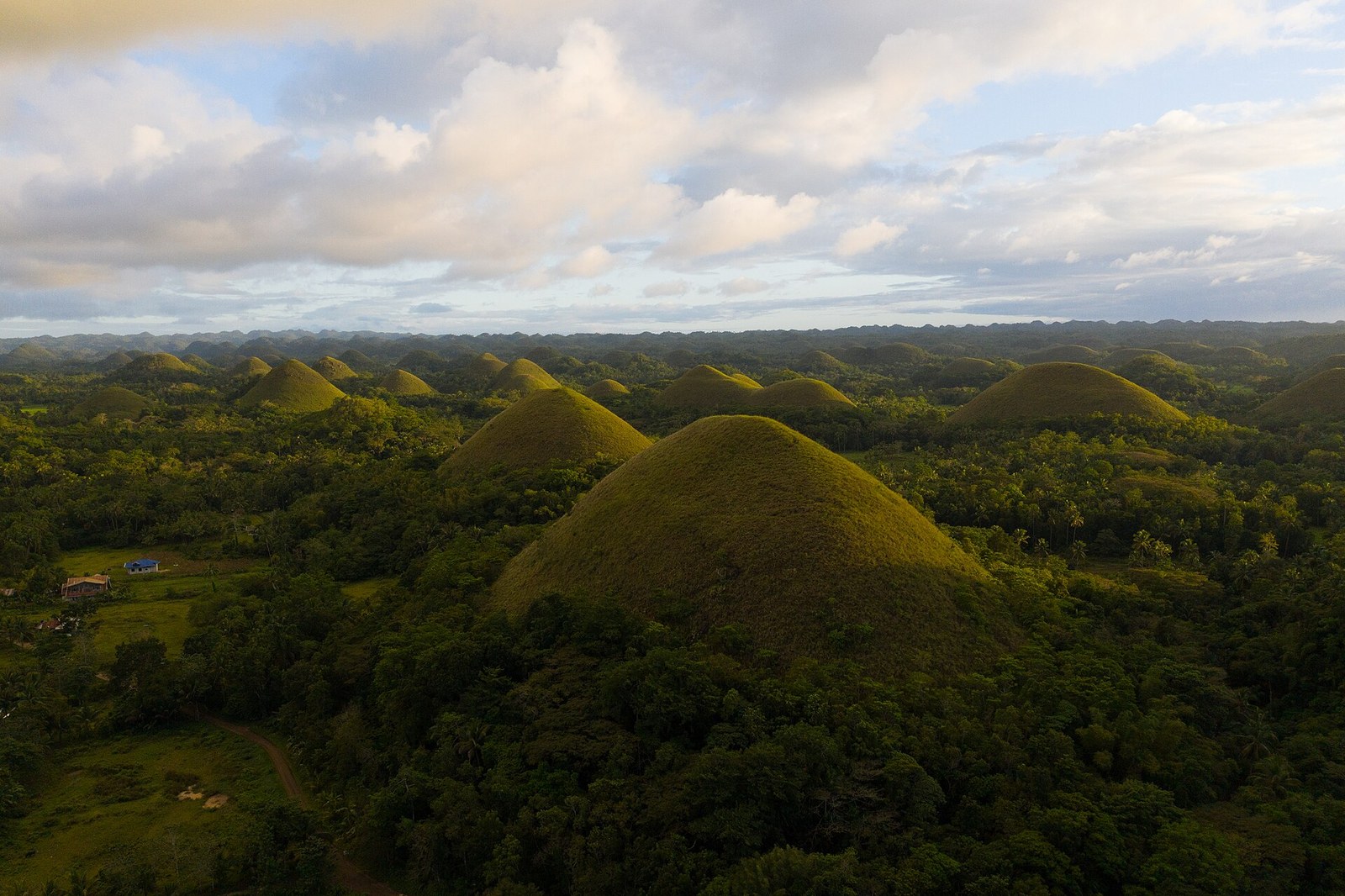
The far end of the road, and the day's climax, is the Chocolate Hills at Carmen, about 55 kilometres from Tagbilaran. The viewing complex sits on one of the hills themselves: 214 steps up to a deck with a full circle view over a landscape that should not, by any ordinary rule, exist.
Book the Bohol day tour from Cebuvia Klook · affiliate link
The tarsier stop, honestly
This is the stop to ask questions about, because Bohol has two tarsier sites and they are not the same thing wearing two names. The genuine sanctuary is the Philippine Tarsier and Wildlife Sanctuary at Canapnapan, Corella, about 14 kilometres from Tagbilaran, run by the Philippine Tarsier Foundation. There the animals live in a large protected forest and sleep through the day in their chosen trees along a trail, with guides who know which tree each tarsier has picked and who keep visitors quiet, at a distance, and off the flash. The rules are the visit: no touching, no flash photography, low voices, because tarsiers are nocturnal, solitary and famously stress prone, and an animal that can be passed hand to hand for photographs is an animal being harmed for them. The second site, the Tarsier Conservation Area near Loboc, is a separate, privately run operation that sits directly on the loop road, which is precisely why so many countryside tours use it: it costs the itinerary no detour. Handling is prohibited there too these days, but it is not the Foundation sanctuary, and roadside tarsier displays in cages, which older visitors may remember, are the past this distinction exists to end. So ask your operator one question before you pay: Corella or Loboc? A tour that answers Corella, and takes the small detour to prove it, is the tour this guide recommends, and if you are travelling independently, Corella is an easy early stop on the drive out from Tagbilaran, before the road commits inland.
The hills themselves
The numbers first, because they are better than the adjectives. The Chocolate Hills are counted at 1,776 in Proclamation No. 1037, the 1997 proclamation that protects them as a national geological monument, spread over more than 50 square kilometres across Carmen, Batuan and Sagbayan: cone after cone of marine limestone, lifted and weathered into near perfect symmetry. For most of the year they are green, as our hero photograph shows. In the dry season the grass cures brown and the field turns the colour that named it, so a November or December visit buys you the green version and no apology is needed for it: the shape, not the colour, is the wonder. Bohol as a whole was named the first UNESCO Global Geopark in the Philippines in 2023, and the hills are its emblem. From the Carmen deck, give it time. The first photograph takes a minute; the strangeness takes about ten, which is when your eye stops counting hills and starts reading the pattern.
Day trip or overnight?
The day trip works, and for a traveller based in Cebu with one spare day it is the correct shape. But Bohol rewards the night. Stay over and the loop slows down: Corella in the quiet of the morning, the hills without the return ferry ticking, and a second day for the island's other half, the water, with dolphin watching and island hopping to Balicasag from Panglao, the beach island joined to Tagbilaran by causeways where most of Bohol's resorts sit along Alona Beach. Panglao is also the gentler arrival if you ever come directly, since Bohol Panglao International Airport sits on the island itself. Book the Cebu base and the Panglao option the same way, and decide by the ferry timetable rather than by enthusiasm: if the early boat horrifies you, that is the island telling you to stay the night.
Stay in Cebu Cityvia Trip.com · affiliate link
Stay in Panglaovia Trip.com · affiliate link
Whichever shape you choose, book in this order: ferry seats or the bundled tour first, because the boats are the day's fixed frame; the room second; and nothing else needs booking at all, since every stop on the loop admits visitors without a booking. Bohol in a day is a long day. It is also, hill for hill and stop for stop, the best value day trip in the central Philippines, and the ferry ride home at dusk, with Cebu's lights coming up across the strait, is a better ending than most day trips manage.
More reading on the articles page, or go straight to the events calendar.
Noteworthy events direct to your inbox.
Get what's noteworthy for the weekend and beyond every Wednesday in your inbox.