
What's on · Sun 22 Nov 2026
Boracay: the island under its new rules
Boracay closed for six months in 2018 and reopened as a different island: capped numbers, accredited hotels only, a port arrival that runs on registrations and fees, and a White Beach with rules where the party strip used to be. This evergreen guide explains the island as it now works, from the Caticlan jetty formalities to the three stations of White Beach, the quiet east coast at Bulabog, and the boat day that earns its money, so a first visit under the new rules goes smoothly from the first queue.
Boracay is the rare famous place that was given a second chance and took it. In April 2018 the Philippines closed the island entirely, for six months, after years of runaway building had overwhelmed its sewers and its single famous beach; the president of the day called it a cesspool, and for once the insult produced a policy. When Boracay reopened that October it was under a regime that still governs it: a carrying capacity study capped the island at 19,215 tourists at any one time, only accredited hotels may take guests, and the beach itself runs on rules. Our New Year guide to Cebu and Boracay covers the island at countdown time. This is the evergreen version: how Boracay works now, on any week of the year, and how to work it properly.
Arrival is a procedure, and that is the point
Boracay has no airport. You fly to Caticlan, ten minutes from the jetty, or to Kalibo, about two hours away by road, and every route converges on Caticlan Jetty Port for the short boat crossing to Cagban Port on the island. At the jetty the new Boracay announces itself: registration, identity documents, and a small stack of separate charges, a terminal fee, an environmental fee and the boat fare, paid before you board. The province's Boracay iPass system lets you register and prepay those charges online and arrive with a QR code that is scanned on entry and again on exit, which is the version of arrival this guide recommends; the queues at the port are the tax on deciding otherwise. Two arrival rules matter more than the fees. Your hotel must be accredited by the Department of Tourism, because accredited booking is the basis on which tourists are admitted, so check the accreditation when you book rather than at the port. And keep the paperwork, booking confirmation and ID, reachable rather than buried: the crossing itself takes ten to fifteen minutes, and the formalities around it take longer than the boat.
White Beach, in its three stations
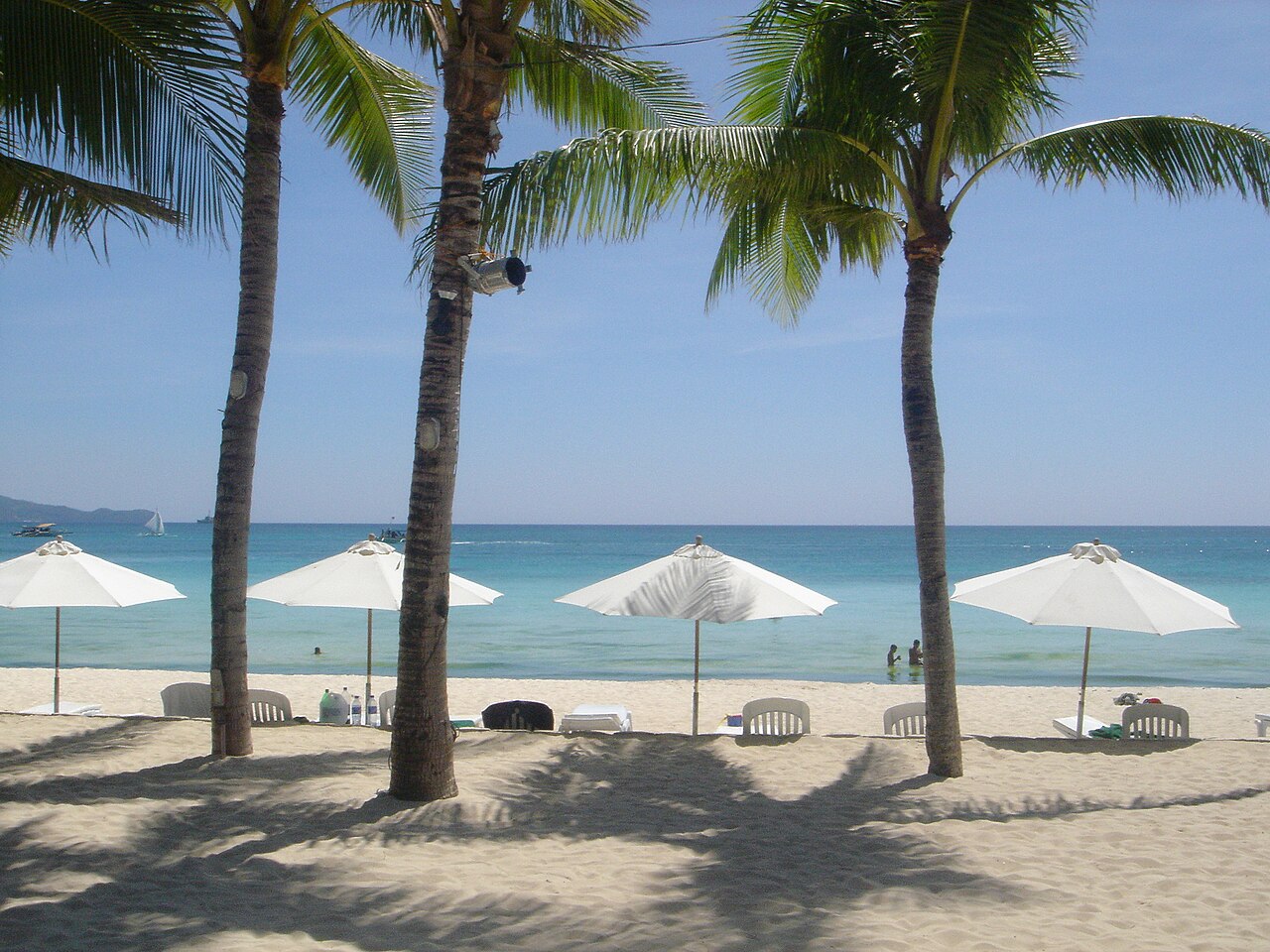
The beach that carries the island is four kilometres of pale sand on the west coast, and it divides into three stations that are really three temperaments. Station 1, at the northern end, is the wide, quiet, expensive stretch, where the sand is broadest and the resorts keep their distance from each other; Willy's Rock, the volcanic outcrop with its small grotto, stands in the shallows as the beach's landmark and photograph. Station 2 is the middle and the metabolism: D'Mall, the island's open-air commercial heart, sits just behind the beach path, and the restaurants, dive shops and bars concentrate here. Station 3, to the south, is the older, leafier, cheaper end, where the path narrows and the pace drops. The beach path runs the length of it all, and the correct Boracay day is built on foot along it.
The rules are part of the scenery now. There is no smoking and no drinking on White Beach itself; the beach bars serve behind their lines, and the sunset drink happens at a table, not on the sand. Dining on the sand, beach parties and the old free-for-all furniture sprawl went with the rehabilitation, as did single-use plastics across the island's businesses, and sandcastle building is a permitted activity rather than a hustle. None of this has made the beach less beautiful. It has made it legible: a public beach with a dress code of behaviour, patrolled and cleaned, where the sunset paraw sailboats still line up in the late afternoon exactly as they always did, now against a shoreline that can breathe.
The other coasts
Boracay is a small island with more than one face, and the new rules reward exploring them. Bulabog Beach, on the east coast a short walk across the island's narrow waist from Station 2, is the wind side: the kiteboarding and windsurfing beach, lively in the amihan wind season, with its own strip of schools and cafes and a boardwalk energy entirely different from White Beach's calm. Puka Shell Beach, at the northern tip, is the island's excursion beach, coarser sand full of the puka shells it is named for, fewer people, a row of grill shacks, and the feeling of having left the resort island behind for an afternoon. Diniwid Beach, a cove just north of Station 1 reached by a cliff path, is the small, local alternative when White Beach feels staged. Between them, a visitor who only sees the west coast at sunset has seen the postcard and missed the island.
Book the Boracay island hopping tourvia Klook · affiliate link
The one paid day that earns its money is the boat. The standard island hopping circuit runs out to the snorkelling water around Crocodile Island and Crystal Cove, with a grilled lunch and beach stops, and the tour above is the island's established version of it, thousands of bookings deep. Go on a morning sailing, when the water is calmest and the snorkel sites are clearest, and treat the afternoon as beach time rather than booking a second activity into the heat.
What the rules changed, honestly
It is worth saying plainly what the new Boracay is like to be on, because the rehabilitation is now the island's defining fact and visitors arrive with two opposite fears, that it has been ruined by rules or ruined by crowds. Neither is true. What the closure bought is visible in the water first: the west coast shallows are clear in a way older visitors describe with disbelief, because the outfalls that once drained toward the beach were the closure's main target. What it cost is the old improvisation: you cannot drift onto this island with a backpack and a hope, sleep anywhere cheap and party on the sand, because the accredited room, the port registration and the beach rules are the island now. In exchange, the systems work. The e tricycles that replaced the old transport run the main road in a steady electric stream, the beach is cleaned and patrolled, and the famous sunset, paraws crossing a gold sea in front of a quiet shoreline, is better theatre than the beach party ever was. Peak weeks still test the cap, Holy Week above all, when arrivals have pushed past the study's number in recent years despite the regime; come outside the great Philippine holidays and the island the study imagined is the island you get.
Where to stay, and how long
Match the station to the trip. Station 1 for quiet and the best sand, in the accredited resorts set back from the path. Station 2 for first-timers who want the island's whole menu within a five-minute walk and accept the buzz that comes with it. Station 3 for value and shade. Wherever you book, the accreditation check is the one non-negotiable, and the second is to book the room before the flights if your dates touch any Philippine holiday, because the cap means the island's best rooms are a fixed pool that sells out rather than a market that expands. Three nights is the honest minimum the journey justifies; four gives you the boat day, both coasts and one day of doing nothing at professional standard, which on Boracay is not a wasted day but the entire point of the place, properly worked. Leave the island the way you arrived, by the Cagban jetty and the same short crossing, with the iPass code scanned on the way out and the fees' second half settled, and the last view is the one the rehabilitation was for: a white beach, a clear sea, and an island that looks, again, like the photographs that made it famous.
Stay in Boracayvia Trip.com · affiliate link
---
More reading on the articles page, or go straight to the events calendar.
Noteworthy events direct to your inbox.
Get what's noteworthy for the weekend and beyond every Wednesday in your inbox.